
Identify Suspected Moisture Intrusion Before It Leads to More Extensive Building Damage.
Water intrusion is a common concern in commercial buildings. Leaking roofs, deteriorated exterior sealants, plumbing leaks, and building envelope deficiencies can allow moisture to enter concealed or difficult-to-access areas.
At Southeast Building Consultants, LLC, we offer commercial infrared moisture inspections to help identify unusual thermal patterns that may be associated with moisture intrusion or water-damaged building materials.
Our services are available as stand-alone moisture investigations or as optional add-ons to Property Condition Assessments (PCAs), Commercial Building Inspections, and Facility Condition Assessments (FCAs).
What Is an Infrared Moisture Inspection?
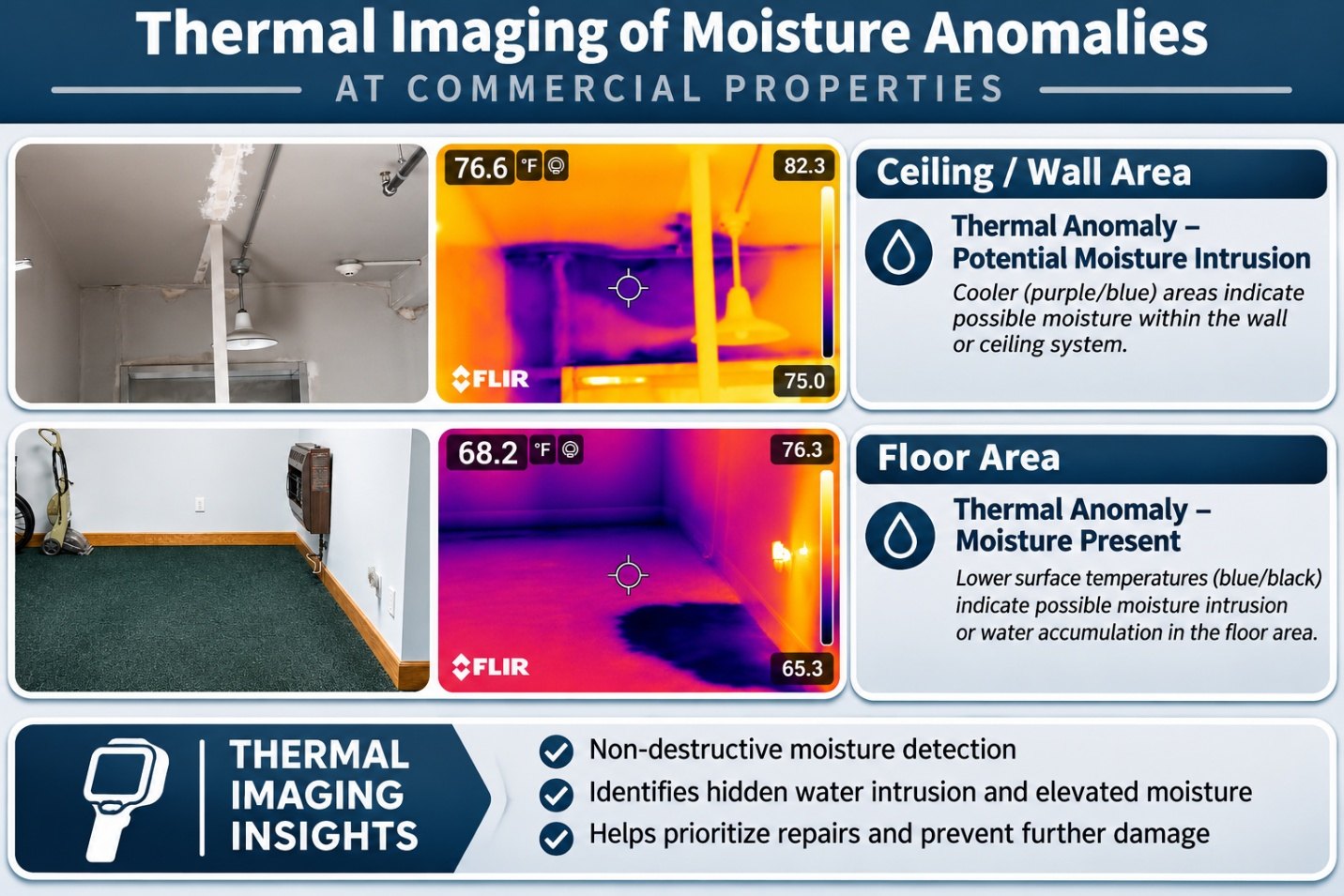
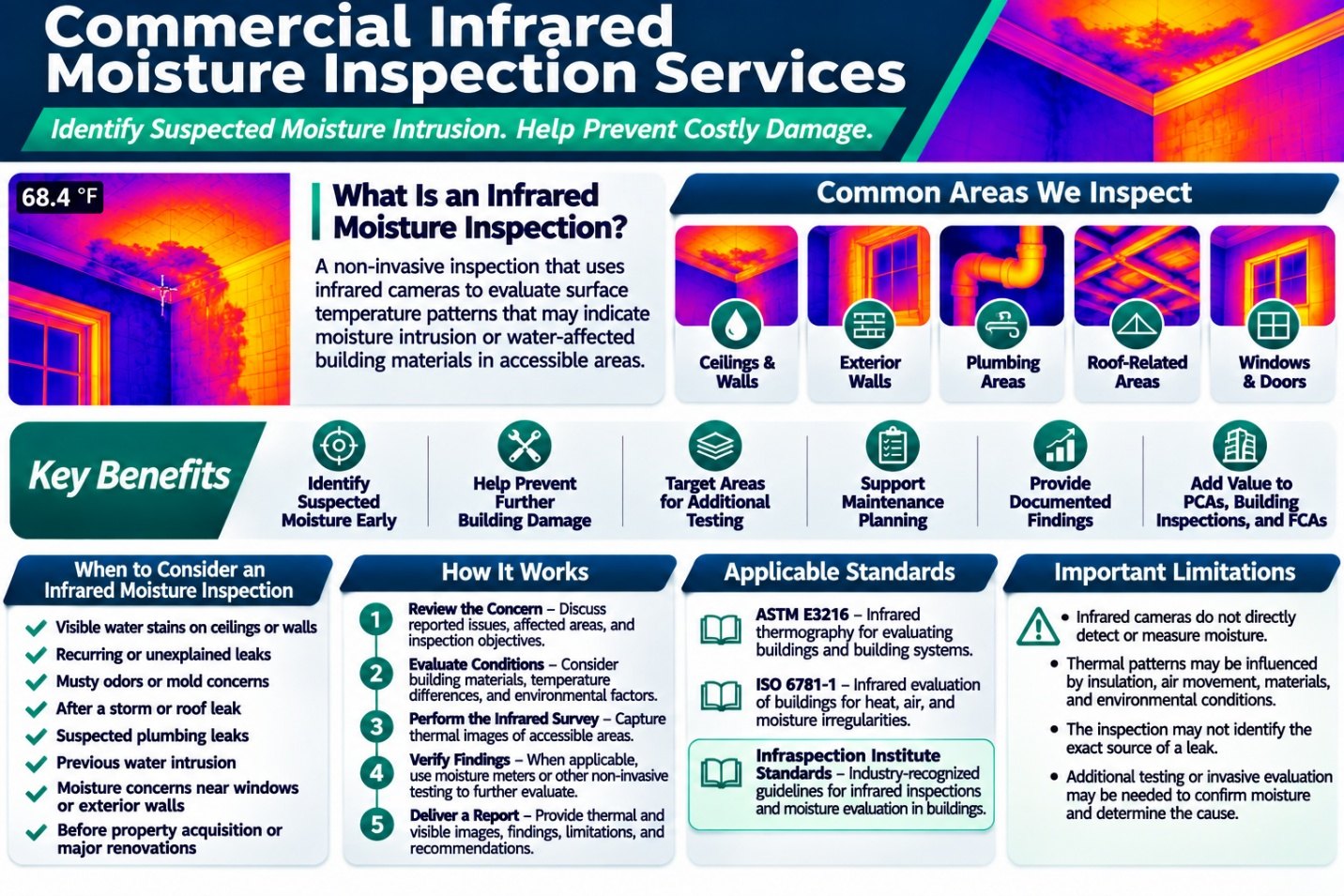
An infrared moisture inspection uses thermal imaging technology to evaluate apparent surface temperature patterns that may indicate the presence of moisture in building materials.
Moisture can affect surface temperatures through evaporation, differences in thermal conductivity, and other physical processes. Under suitable conditions, these differences may be visible through an infrared camera.
However, thermal imaging does not directly measure moisture content or confirm the presence of water.
Suspected moisture-related anomalies should be evaluated using appropriate moisture meters, visual observations, or other verification methods.
What Areas Can Be Evaluated?
Interior Walls and Ceilings
Infrared imaging may help identify thermal irregularities associated with suspected moisture intrusion behind or within accessible wall and ceiling assemblies.
Common concerns include water staining, damp materials, concealed leaks, and moisture migration.
Exterior Walls and Building Envelopes
Water may enter through deteriorated sealants, exterior wall joints, windows, doors, and other building envelope penetrations.
Thermal imaging can help identify areas where unusual temperature patterns warrant additional investigation.
Plumbing-Related Moisture
Infrared inspections may help locate suspected moisture associated with plumbing leaks in accessible wall, ceiling, and floor surfaces.
The effectiveness of the inspection depends on the location of the plumbing, building materials, water temperature, and other conditions.
Roof-Related Water Intrusion
Interior thermal imaging may help identify moisture-related anomalies beneath roof assemblies.
Specialized infrared roof moisture surveys are a separate application and may require different equipment, procedures, and environmental conditions.
Areas With Previous Water Damage
Infrared imaging may be useful when evaluating areas with a history of water intrusion, particularly when visible evidence is limited.
Common Signs of Moisture Problems
A commercial infrared moisture inspection may be appropriate when a property has:
- Water stains on ceilings or walls
- Recurring leaks after rainfall
- Deteriorated interior finishes
- Musty odors
- Suspected plumbing leaks
- Previous water intrusion
- Moisture concerns near windows or exterior walls
- Unexplained deterioration of building materials
These conditions do not necessarily establish the presence of concealed moisture, but they may justify additional investigation.
How Does an Infrared Moisture Inspection Work?
Step 1 — Review the Moisture Concern
We discuss reported leaks, previous water damage, affected areas, and available building information.
Step 2 — Evaluate Inspection Conditions
We consider temperature differences, building materials, recent weather, moisture history, and other conditions that may influence infrared findings.
Step 3 — Perform the Thermal Survey
Accessible surfaces are evaluated for unusual temperature patterns that may be associated with moisture.
Step 4 — Conduct Supporting Evaluation
When included in the inspection scope, appropriate moisture measurements or other non-invasive observations may be used to help evaluate suspected moisture anomalies.
Step 5 — Document Findings
The inspection report identifies relevant thermal observations, locations of concern, limitations, and recommendations for additional evaluation when necessary.
Benefits of Infrared Moisture Inspections
Non-Invasive Investigation
Thermal imaging may help identify areas of concern without initially removing walls or ceiling finishes.
Targeted Moisture Evaluation
Infrared findings can help focus additional moisture measurements or testing on specific locations.
Better Maintenance Planning
Documented moisture concerns can help facility managers prioritize further investigation and corrective work.
Support for Property Transactions
Infrared moisture inspections may provide supplemental information during commercial property evaluations and due diligence.
Improved Documentation
Thermal and visible-light photographs help communicate suspected moisture-related conditions.
Infrared Moisture Inspection Standards
Depending on the inspection application, relevant technical guidance may include:
- ASTM E3216 — General infrared evaluation of buildings and building systems.
- ISO 6781-1 — Infrared procedures for evaluating heat, air, and moisture irregularities in buildings.
- ASTM C1153 — Specialized infrared moisture surveys of applicable roofing systems.
- Infraspection Standards - Infrared Thermography Standards & ASNT Certification
These standards apply to different inspection situations and are not interchangeable.
Certified Infrared Thermography Expertise
Our infrared inspection services are supported by:
- Level I Infrared Thermography Certification — Infraspection Institute
- Affiliated Level III Thermography Consulting Support — ITC/FLIR
The inspection approach and personnel involvement depend on the project requirements.
Important Inspection Limitations
Infrared thermography cannot independently confirm concealed moisture, identify the precise source of every leak, or determine whether mold is present.
Thermal anomalies may result from insulation differences, air movement, reflective surfaces, building materials, or other conditions unrelated to moisture.
Additional moisture testing, invasive investigation, or specialist evaluation may be necessary.
Frequently Asked Questions
Can infrared cameras detect water behind walls?
Infrared cameras do not see water through walls. They may identify temperature patterns on visible surfaces associated with concealed moisture.
Can thermal imaging find the exact source of a leak?
Not always. Thermal imaging may help locate affected areas, but tracing the source of water intrusion often requires additional investigation.
Does an infrared moisture inspection include mold testing?
No. Thermal imaging does not detect mold. Mold assessment or sampling requires a separate service.
Can an infrared moisture inspection be performed after a storm?
Yes, although the usefulness of the results depends on weather, building conditions, and the inspection objectives.
Can this service be added to a PCA or FCA?
Yes. Southeast Building Consultants offers infrared moisture evaluations as stand-alone services or optional additions to commercial building assessments.
Schedule an Infrared Moisture Inspection
Investigate Suspected Water Intrusion With Advanced Infrared Technology.
Southeast Building Consultants, LLC provides commercial infrared moisture inspection services to help property owners and facility managers identify areas requiring further investigation.